 Looks rare
 marketplace routes and verifiable NFT state changes
- last updated
Looks rare brings NFT listings, offers, raffles and protocol rewards into one marketplace interface. Its aggregator can surface orders from more than one source, while settlement still occurs through a wallet-approved blockchain action. Compare the collection contract, token ID, order terms, payment asset and final wallet request before committing. A completed trade needs a successful transaction and a matching ownership record, not merely a listing card or success message.
Jump to a section
Compare the executable order and live wallet request, then confirm settlement through the transaction record and the NFT’s ownership state.
From a candidate listing to confirmed ownership
A usable marketplace route begins with the exact asset and ends with a reconciled wallet state.
The collection contract and token ID establish which NFT an order concerns. A name, thumbnail or collection badge can help with navigation, but those display fields don’t replace the underlying identifiers. The order also has a maker, payment asset, amount, expiry and execution source. If several cards point to the same token, compare their executable terms rather than assuming they describe one shared order.
Next comes live validation. The seller must still control the asset and the necessary approval must remain active. The buyer needs the required payment asset and enough native currency for network gas. Expired, cancelled or already fulfilled orders can’t produce the advertised state change. A wallet request should match the intended asset, payment and contract interaction before the transaction is submitted.
Completion has two connected records. The transaction receipt must show successful execution, and the NFT contract must assign the token or quantity to the buyer. Payment balances should reflect the settled consideration, while the gas payer’s native currency balance should reflect gas. A marketplace interface may index those changes later, so its activity panel isn’t the sole record of ownership.
The commitment boundary for listings and offers
Wallet actions divide order preparation from settlement, and the distinction changes what the user can verify.
Order intent and executable state
A signed listing or offer records terms without itself transferring the NFT. An approval similarly authorizes a contract or operator to act within a defined scope, but ownership remains with the holder. Execution still depends on current ownership, sufficient payment, unexpired terms and valid authorization. Any of those inputs can change after an order first appears.
An item offer targets one token, while a collection offer can be accepted by an eligible holder within that collection. The offer’s payment asset and active balance matter at acceptance time. Once a collection offer has been fulfilled, it can’t also purchase another item through that same completed order.
State evidence after fulfillment
Settlement evidence links the successful transaction to both sides of the exchange.
Buyer record
The buyer’s record should show the expected token contract and token ID. ERC-721 assigns one owner to a token ID, while ERC-1155 records a balance for each account and token ID. The wallet’s displayed gallery may lag behind those contract values or omit media while metadata loads.
Seller record
The seller should no longer hold the transferred ERC-721 token or should have a reduced ERC-1155 balance. Payment changes must be reconciled against the order’s consideration and fee allocations, while gas belongs to the account that submitted the transaction. The seller’s net receipt can therefore differ from the amount shown as the buyer’s total debit.
Can an aggregated listing change the route?
Aggregation can change which marketplace order and execution contract a purchase uses without changing the NFT’s contract identity.
The aggregator can execute orders from multiple marketplace sources within one transaction. Its architecture delegates each order to a source-specific proxy, so apparently similar listings may follow different contract calls. ERC-20-denominated purchases can also require a different entry point from purchases using native ETH.
Compare the source order, currency, expiry and complete wallet request for each candidate route. A lower displayed amount may not mean a lower buyer debit once any additional wallet value and network gas are included. If a cart contains several NFTs, confirm every token after settlement because one interface action can represent more than one underlying order.
A worked route from selection to reconciliation
Hypothetical purchase with an expiring order
In this hypothetical case, the collection contract, token ID, source order, seller, payment asset, displayed total, expiry and connected wallet are all illustrative inputs. Before submitting, the buyer matches the collection contract and token ID across the item view, order terms and wallet request. The order can execute only while the seller owns the token and the quoted terms remain valid.
On the normal path, the wallet already holds the required payment asset and native currency for gas. The buyer grants only the approval requested for that route, if one is required, and then submits the fulfillment transaction. The receipt succeeds, the ERC-721 ownership query returns the buyer’s address and the seller is no longer recorded as owner. Together, the successful receipt and ownership query confirm the transfer.
The order may expire after review but before submission. Validation may stop the purchase before broadcast, or a submitted transaction may revert. Ownership then remains with the seller and the buyer keeps the purchase funds. If a reverted transaction was mined, the buyer may still have paid gas.
If the transaction succeeds, the ownership query shows the buyer; if expiry stops the trade, the seller remains the owner. A listing that remains visible after expiry doesn’t alter either contract state.
Purchase, offer and sale paths
Each trading path commits at a different moment, even when the final settlement transfers the same NFT.
- A fixed-price purchase fulfills an active sell order through a wallet transaction.
- An item offer creates terms for one identified NFT and transfers ownership only if an eligible owner accepts it.
- A collection offer applies to eligible items in one collection and is consumed when a holder successfully accepts it.
- A fixed-price listing lets the owner publish sale terms after the required authorization and wallet confirmation.
Approvals, signatures and settlement transactions aren’t interchangeable. Signing can authorize an order without sending an on-chain transaction, while an approval transaction grants or changes permission to transfer assets on a token contract. Fulfillment is the action that exchanges the NFT and payment. Before confirming, identify whether the wallet requests a signature, an approval transaction or a settlement transaction, then check the contract, any transaction value and the permission scope shown.
Collection approvals deserve separate attention because an operator approval can cover more than one NFT from the same contract. Revoking it can block open listings that depend on that authority. Leaving it active doesn’t keep a listing executable when another condition, such as ownership or expiry, has already changed.
Raffles and protocol rewards
Raffles and protocol rewards use separate state paths from an ordinary NFT sale. A raffle entry doesn’t establish ownership of the prize; the resolved raffle and resulting transfer determine the winner’s state. Committing LOOKS relates to the protocol’s reward mechanism, not proof that an NFT purchase succeeded. Verify a raffle through its resolution record, rewards through the resulting balance and a marketplace trade through the completed transfer.
Reconciling interface and wallet records
Reconciliation depends on the transaction receipt, token state and payment state agreeing about what occurred.
A successful receipt shows that the submitted contract call completed rather than reverted. Its logs can identify transfers and related payment movements. A pending transaction has not reached that state, while a failed transaction doesn’t transfer the NFT through the reverted call. Gas may still be charged for work performed before a revert.
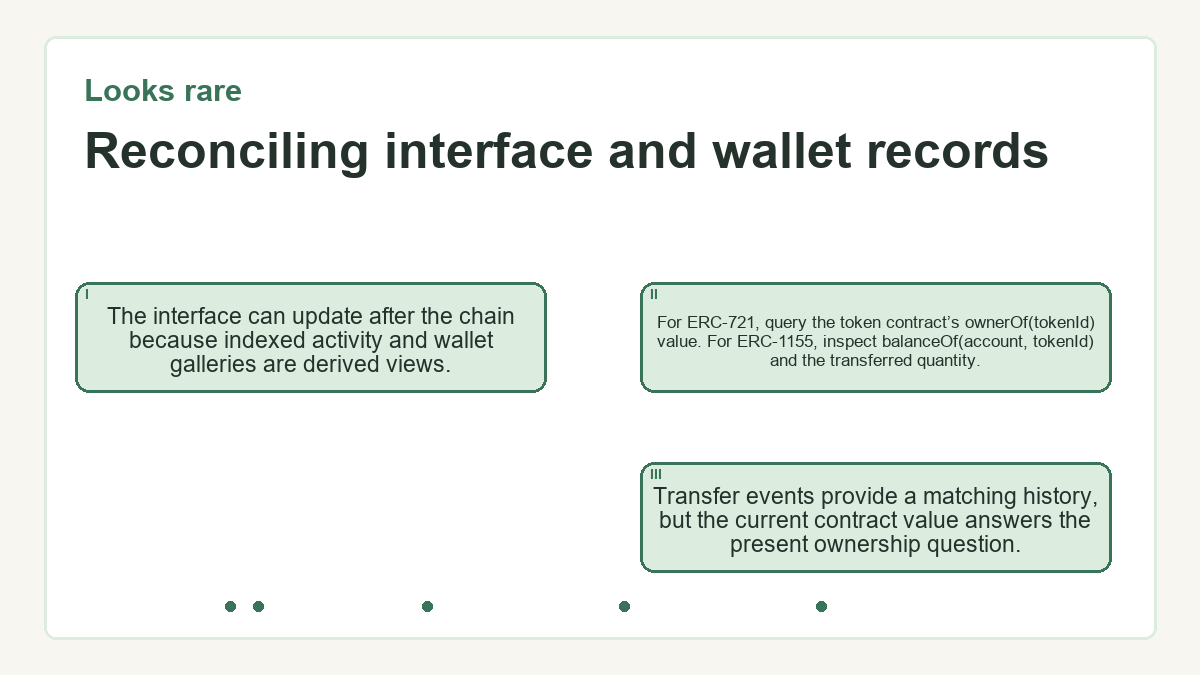
The interface can update after the chain because indexed activity and wallet galleries are derived views. For ERC-721, query the token contract’s
ownerOf(tokenId)
value. For ERC-1155, inspect
balanceOf(account, tokenId)
and the transferred quantity. Transfer events provide a matching history, but the current contract value answers the present ownership question.
If the NFT state changed but the payment looks unexpected, compare the transaction’s consideration recipients and fee allocations with the confirmed order. If payment or gas changed without an NFT transfer, identify whether the submitted action was an approval, a wrapping transaction or a failed fulfillment. Those actions have different outcomes despite appearing in the same wallet history.
Closing orders and remaining authority
A clean exit separates order cancellation, expiry and token approval because each controls a different part of the route.
Cancelling an open order invalidates its trading terms through the applicable mechanism. Expiry makes the order unusable after its deadline. Revoking an operator approval removes the contract’s authority over the covered tokens, which can also stop other listings that rely on it. Disconnecting a wallet from the interface does none of those things by itself.
After a sale, stale order cards may remain visible until marketplace indexes catch up. The sold token’s current contract state decides whether any old order can still execute. For an ERC-721 sale,
ownerOf(tokenId)
returning the buyer’s address is the decisive ownership result. For an ERC-1155 sale, the buyer’s increased
balanceOf(account, tokenId)
supplies the corresponding figure.
Common questions about Looks rare
What costs can appear before an NFT purchase completes?
A buyer may pay network gas and may need a separate transaction to approve or prepare the payment asset. Gas varies with network demand. Marketplace or protocol fees and creator fees can also be part of settlement, but the active order and execution source determine their allocation. Compare the final wallet request and confirmed fee allocations with the quoted consideration, and remember that a seller’s net receipt can differ from a buyer’s total debit.
Is WETH required for every marketplace action?
No, the required payment asset comes from the active order and execution path. Fixed-price purchases may use ETH, while item and collection offers have commonly used WETH. The aggregation architecture can also execute ERC-20-denominated orders. The wallet needs the payment asset specified by that particular order and enough native currency for gas, so the final transaction request should match the route being accepted.
Can I trade NFTs without holding LOOKS?
Holding LOOKS isn’t a universal prerequisite for buying or selling an NFT. The marketplace order determines the payment asset, amount and necessary approvals. LOOKS has separate protocol reward and utility functions, so committing it belongs to the rewards path rather than basic trade settlement. A supported listing denominated in another asset can complete without changing the trader’s LOOKS balance.
How can I distinguish the intended NFT collection from a copy?
Use the chain, collection contract and token ID as the NFT’s identity. A copied name, image or symbol doesn’t create the same asset, and a display badge isn’t a substitute for those identifiers. Match the contract and token ID shown in the order with the values requested by the wallet. For ERC-721, that pair identifies one token within its contract.
Does confirmed ownership guarantee that the NFT artwork cannot change?
No, a confirmed transfer proves that the token’s ownership state changed, but it doesn’t automatically freeze its image or metadata. Persistence depends on the token contract and metadata design, including how the URI and underlying content are stored or controlled. Ownership and media permanence are separate properties, so a correct owner record doesn’t establish that every displayed attribute will remain unchanged.
What happens to a listing after the NFT moves to another wallet?
The listing generally becomes unfillable because its maker no longer owns the token, although an indexed marketplace view may continue showing it temporarily. Settlement should fail rather than transfer an NFT from its new owner. Moving the token back doesn’t necessarily revive the order because it may also have expired, been cancelled or become invalid through an order nonce change.
Are confirmed NFT trades reversible through the marketplace?
A successfully settled blockchain trade isn’t normally reversible through ordinary marketplace controls. Cancellation applies to an open order before fulfillment, not to a completed token transfer. Correcting a mistaken transfer would require cooperation from the current owner or a separate mechanism in the relevant contract. The marketplace interface cannot unilaterally rewrite the token contract’s ownership record after settlement.